1
Merchant
The merchant makes the product and sets the commission terms. That might be a software company, a course creator, an ecommerce brand, or a marketplace listing multiple offers.
Beginner Article
The simplest useful explanation of the model, the money flow, and what beginners should focus on first.
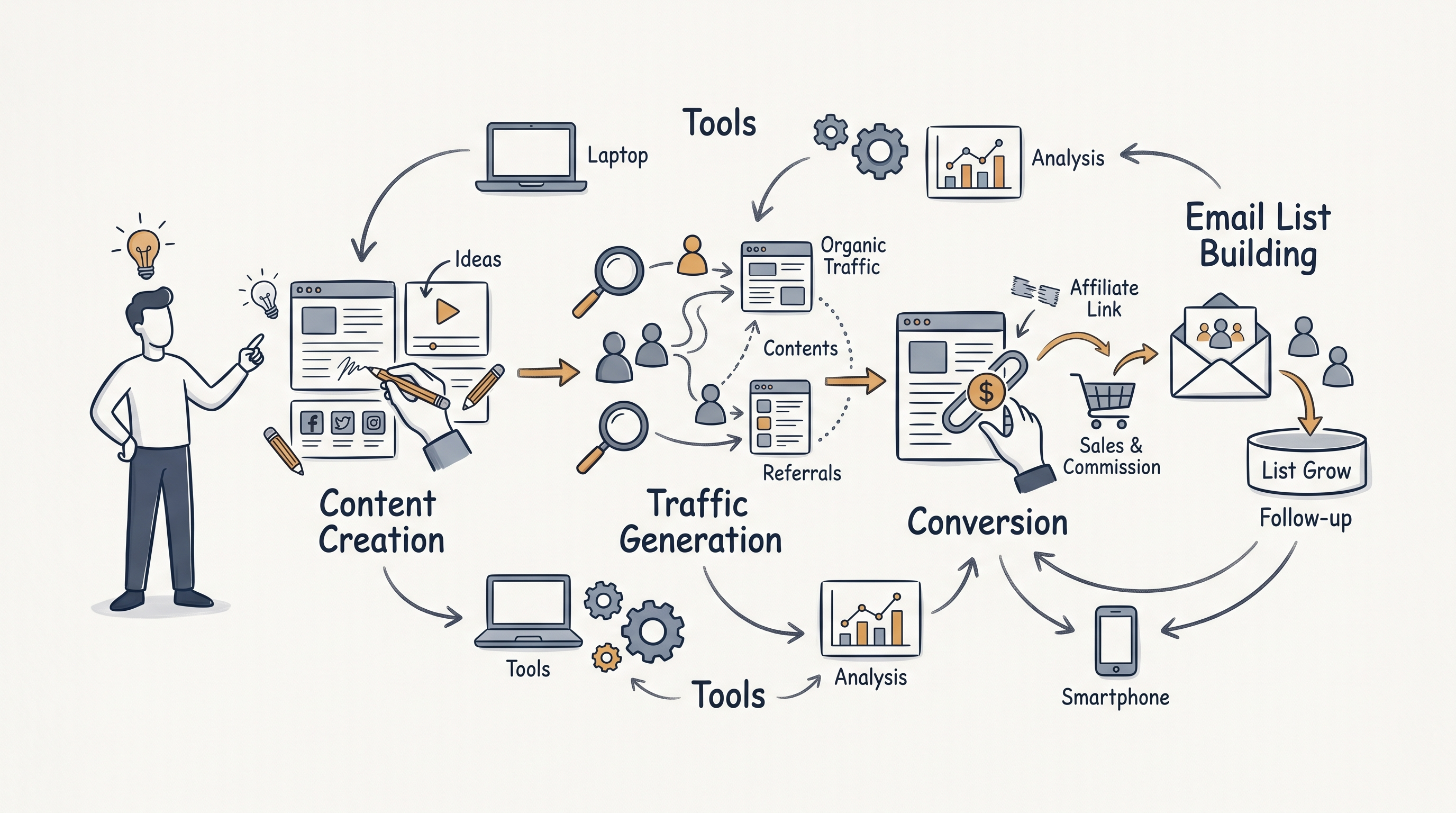
The short version
Affiliate marketing is simple at the surface and a little more nuanced underneath. You recommend a product or service using a tracking link. If someone buys through that link, you earn a commission.
The real skill is not placing links. The real skill is matching a reader's problem with a useful recommendation and giving them enough context to trust it.
The workflow
Once you understand these four pieces, the model stops feeling vague. It becomes a process you can map, improve, and test.
The merchant makes the product and sets the commission terms. That might be a software company, a course creator, an ecommerce brand, or a marketplace listing multiple offers.
You create useful content, build trust, and point the right person toward the right offer. Your job is not to spray links everywhere. Your job is to help someone make a better decision.
The customer clicks because your article, video, or email answered a real question. That is why relevance beats volume. A smaller audience with stronger intent usually converts better than random traffic.
Affiliate platforms track the click, the sale, and your commission. Cookies, tags, and platform dashboards connect the purchase back to your recommendation so the payout gets credited correctly.
What actually makes it work
Beginners sometimes imagine affiliate marketing as a trick. It is not. The model works best when your content reduces uncertainty instead of adding more noise.
Tutorials, comparisons, buyer guides, and honest fit analysis tend to outperform flashy claims because they help the reader make a clearer decision. A person who feels informed is much more likely to click with confidence.
That is why a good affiliate page often looks boring at first glance. It answers the question, shows the trade-offs, and only then points to the offer.
A beginner workflow
You do not need a giant site to understand how the model works. A lean setup is enough to prove the basics.
Action step
What builds trust
The mechanics matter, but the conversion usually comes from clarity, relevance, and consistency.
A reader should understand the problem and the tradeoffs before you ask for the click.
Pages tied to one clear question usually convert better than generic pages trying to do everything.
A simple publishing rhythm and clear offer fit beat fancy funnels that never get finished.
Next step
If this model makes sense now, the next move is not to obsess over software. It is to choose a niche, publish something useful, and learn from the response.
If you want that roadmap in plain language, read how to start affiliate marketing next.
These guides help you turn the basic model into a real beginner plan.
Go back to the main beginner guide if you want the bigger picture before choosing your first niche or offer.
Return to Affiliate Marketing for Beginners