Beginner Guide
Affiliate Marketing for Beginners
Everything you need to understand before you start — explained in plain language with zero hype.
Start here
The Fundamentals
What Is Affiliate Marketing?
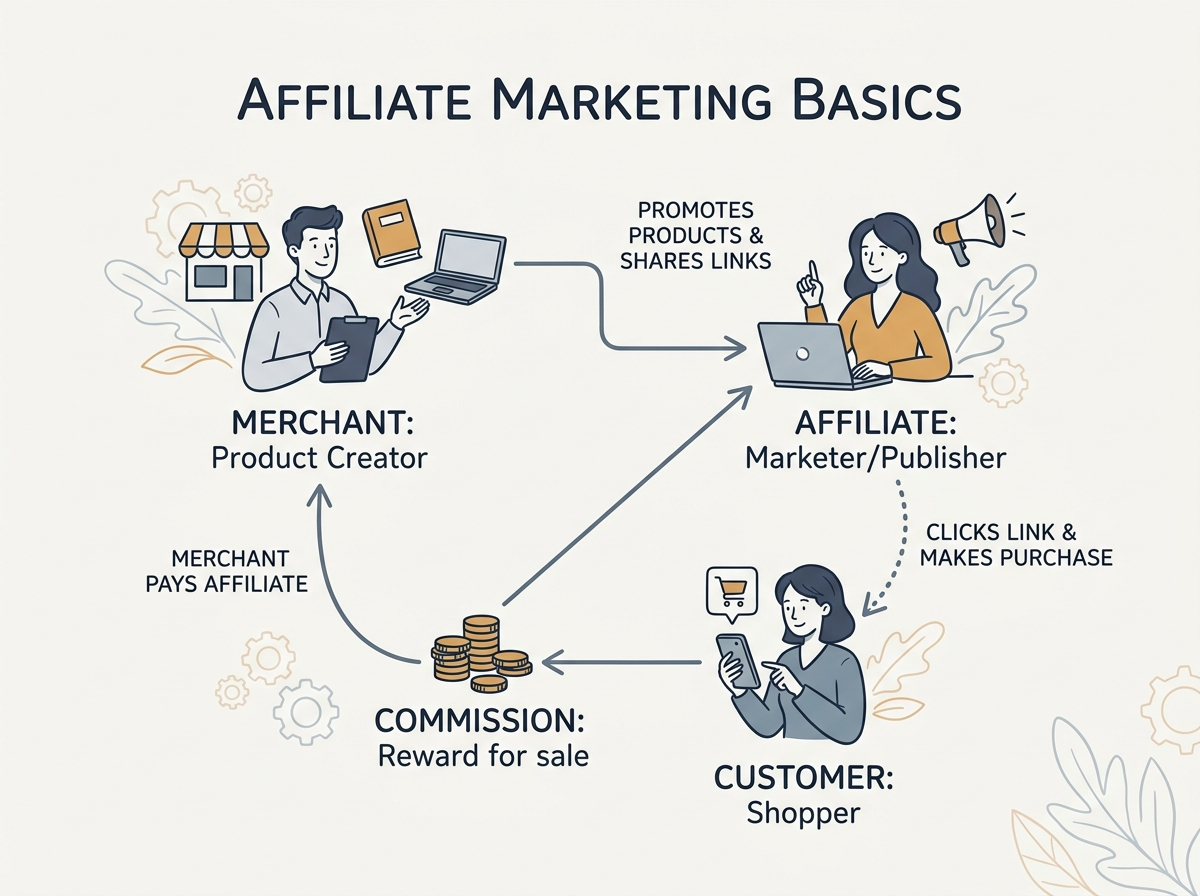
You recommend a product online using a special tracking link. When someone clicks that link and buys, you earn a commission. You never touch inventory, handle shipping, or deal with refunds. Your job is connecting the right person with the right product through helpful content.
Who Is Involved?
Four parties: the merchant (who makes the product), you (the affiliate who recommends it), the customer (who buys), and the network or platform (which tracks clicks, sales, and payments). As a beginner, you mainly interact with the network dashboard and your own content.
How Do You Get Paid?
Most programs pay per sale. Some pay per lead or per click. Commissions on physical products are typically 3–10%. Digital products often pay 30–50% or more. Payment timelines vary — some programs pay weekly, others monthly, and most hold earnings for 30–60 days before your first payout.
Why Is It Beginner-Friendly?
You skip the hardest parts of starting a business: product creation, fulfillment, and customer support. You can start with a free blog, a single niche topic, and zero upfront investment. The learning curve is real, but the barrier to entry is genuinely low.
Concrete example
What a Real Beginner Setup Looks Like
Imagine you pick "home espresso" as your niche. Here is what the first three months might look like in practice.
Month 1:You set up a simple WordPress blog. You write three articles: "best espresso machines under $300," "how to dial in espresso at home," and "espresso grinder vs. pre-ground coffee." Each article includes an affiliate link to one or two products you actually researched.
Month 2: You add two more articles based on questions you see people asking in Reddit threads and forums. You set up Google Search Console to see which queries bring impressions. Traffic is still tiny. That is normal.
Month 3: One article starts ranking on page two. You improve it with better headings, a comparison table, and a clearer recommendation. You get your first few clicks on affiliate links. Maybe a sale, maybe not yet.
This pace sounds slow. It is. But each article you publish becomes a permanent asset that can attract traffic and earn commissions for months or years. That compounding effect is the actual advantage of the model.
Avoidable traps
Five Mistakes That Stall Most Beginners
Most beginners do not fail because the model is broken. They fail because of habits that are easy to fix once you see them.
- !
Promoting ten products before understanding one
Pick one or two products you have genuinely researched. Write about them from the buyer's perspective. Depth builds trust faster than breadth.
- !
Running paid ads before you have any content
Paid traffic punishes guesswork. Write free content first to learn what your audience actually responds to. You can add ads later when you know what converts.
- !
Choosing a niche only because the commissions are high
High payouts are irrelevant if you cannot write useful content about the topic. You need to sustain publishing for months. Pick something you can explain and stay interested in.
- !
Rewriting your site instead of publishing more content
Beginners often spend weeks redesigning or restructuring instead of writing the next article. Publishing is the engine. Design refinements can wait.
- !
Quitting at month two because nothing happened
Most affiliate content takes 3–6 months to gain traction in search. The first two months almost always feel slow. That is the timeline, not a sign of failure.
Honest expectations
What Should You Realistically Expect?
Months 1–3: Mostly learning and publishing. Very little traffic, very few clicks, probably zero commissions. This is where most people quit.
Months 4–6: A few articles start getting organic traffic. You learn which topics your audience cares about. First commissions may trickle in.
Months 7–12: If you kept publishing and improving, you have a small but growing library of content. Some articles earn consistently. Others do not. You start doubling down on what works.
The important pattern: affiliate income is back-loaded. The work you do in month two might not pay until month six. That delay trips up beginners who expect immediate feedback.
The upside is that a well-written article can keep earning for years with minimal maintenance. That compounding is the real payoff of the model — but only if you stay long enough to reach it.
Action steps
Your First Five Moves
If you are reading this and thinking "I want to try this," here is the simplest starting sequence.
- Pick one niche topic you can write about without dreading it. It does not need to be your passion. It needs to be something you can explain clearly and stay interested in for a few months.
- Set up a basic site. WordPress with a clean theme is fine. A free Substack works too. Do not overthink this step. You can migrate later.
- Write your first three articles targeting specific questions beginners ask. Use Google autocomplete, Reddit, and Quora to find real questions. Answer them better than what currently ranks.
- Join one affiliate program relevant to your niche. Add links naturally inside your articles where they genuinely help the reader.
- Set up Google Search Console from day one. It is free. It shows you which queries bring impressions. That data will guide every decision you make from month two onward.
You do not need to do all five in a single weekend. Spread it across your first two weeks. The point is forward motion, not perfection.
Keep Learning
These articles go deeper into the topics that matter most for beginners.
Ready to Take the Next Step?
Now that you understand the basics, follow the practical step-by-step roadmap to get started.
Go to the Step-by-Step Roadmap