Conversion Strategy
High-Ticket vs. Low-Ticket Affiliate Marketing
Choosing the right commission structure for your audience, traffic, and conversion goals.
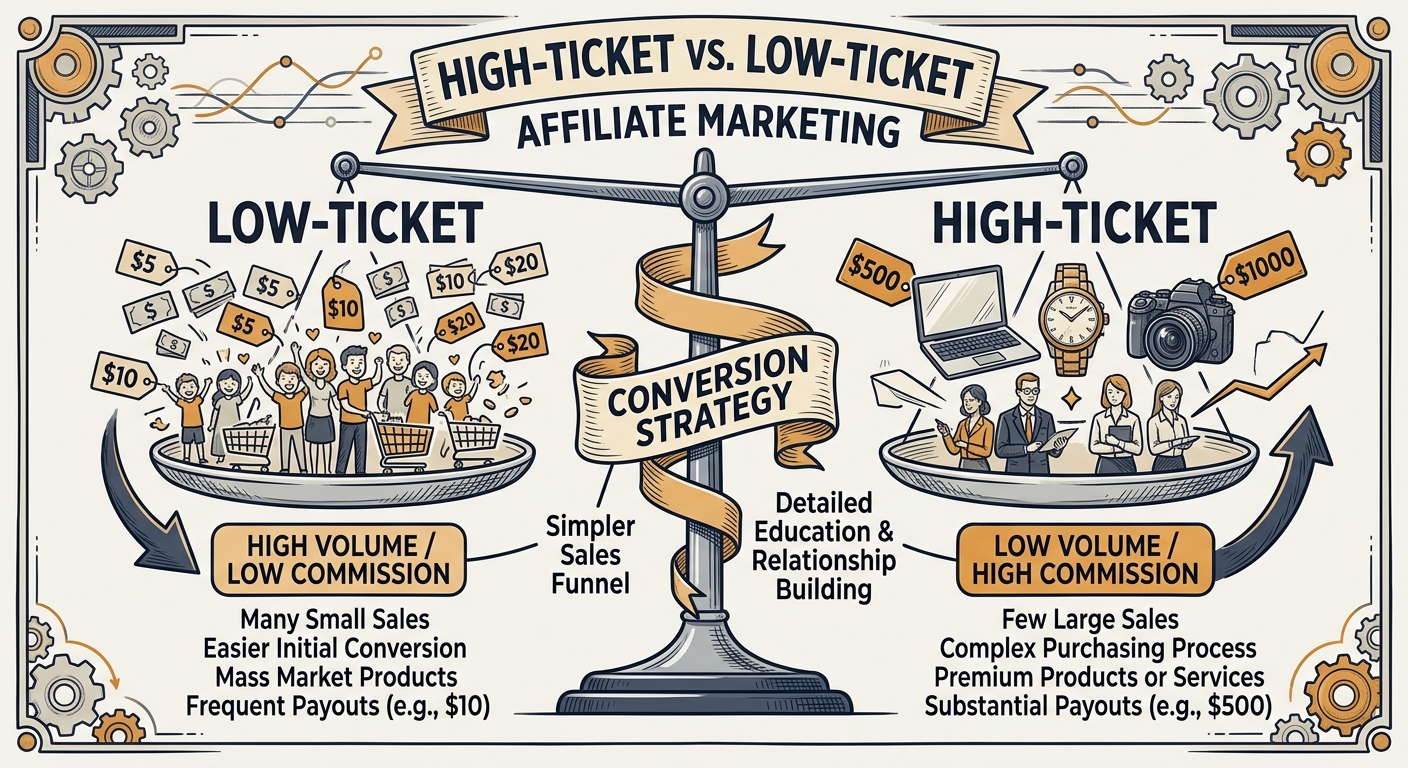
One of the first big decisions you will face as an affiliate is what kind of products to promote. Most offers fall into two main categories: high-ticket and low-ticket.
Low-ticket offers are usually priced under $100. They are easier to sell because the risk for the buyer is low, but you need a lot of volume to make a significant income.
High-ticket offers can cost anywhere from $500 to $5,000 or more. These commissions can change your business with just a few sales, but they require much higher levels of trust and better content.
If you are just starting out, it helps to understand how these models differ in practice so you can pick the one that fits your traffic style.
Volume vs. Value
The Low-Ticket Volume Game
Low-ticket affiliate marketing is often the entry point for beginners. Promoting physical products on Amazon or small digital tools usually means earning $2 to $20 per sale.
The advantage is the "impulse buy." People do not need to think for three weeks before buying a $30 book or a $15 kitchen gadget. This makes low-ticket great for niches with high traffic but lower individual buyer intent.
The challenge is the math. To earn $2,000 a month at a $10 average commission, you need 200 sales. That usually requires thousands of targeted visitors every single month.
Trust vs. Scale
The High-Ticket Trust Game
High-ticket marketing flips the script. Instead of 200 sales, you might only need four sales at a $500 commission to reach that same $2,000 goal.
This model is powerful because you do not need massive traffic to build a full-time income. However, the "selling" process is different. Nobody buys a $2,000 course or a $1,000 software suite on a whim.
You need to provide deep value, answer complex objections, and often use email list building to nurture the lead over time. Trust is the primary currency here.
Comparison
Which One Should You Choose?
The best choice depends on your niche and your strengths.
- Pick Low-Ticket if: You have a broad audience, you are good at generating high traffic (like SEO or social media), and you want to see small wins quickly.
- Pick High-Ticket if: You prefer building deep relationships, you are good at detailed reviews, and you want to earn more per visitor.
Many successful affiliates eventually do both. They use low-ticket products to solve immediate problems and then bridge those same readers toward high-ticket solutions like the ones found in our recommended programs.
Ready to evaluate your first offer?
Now that you know the difference between ticket sizes, the next step is learning how to judge the actual quality of an offer.