Merchant
The merchant owns the product and pays the commission.
Affiliate Marketing 101
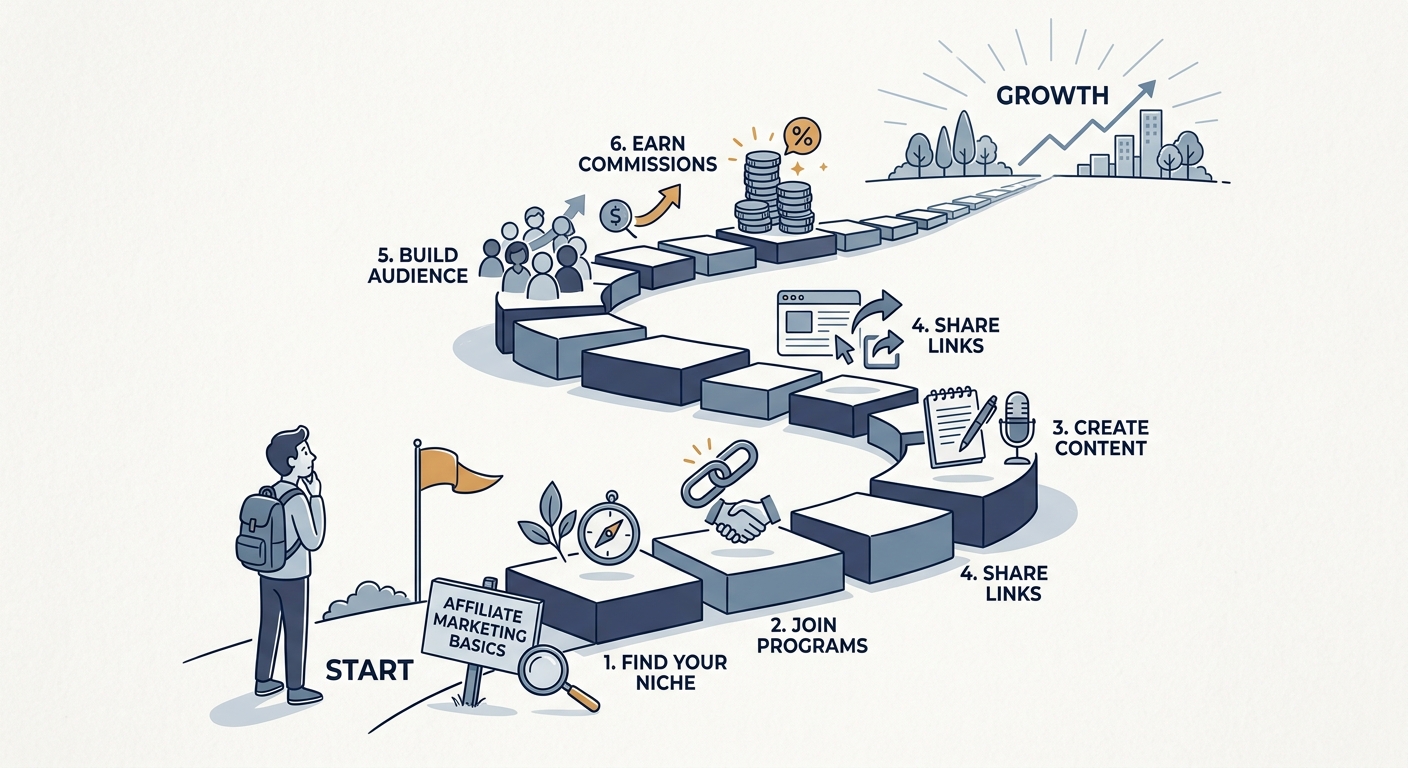
Master the fundamentals without the hype. This guide explains how affiliate marketing really works, why beginners choose it, and what to focus on first.
Start here
Most people first hear about affiliate marketing through loud promises. Easy money. Passive income. Screenshots doing all the talking.
The real version is more grounded and far more useful. Affiliate marketing for beginners is a trust model. You help someone solve a problem, point them to a product that fits, and earn a commission if they buy.
No inventory. No shipping. No support queue at midnight. Just content, context, and a recommendation that makes sense when the reader gets to that moment.
The simple model
A company gives you a tracking link. You publish something useful. A reader clicks, buys, and the sale gets credited back to you.
The merchant owns the product and pays the commission.
You create the content, build trust, and connect the right reader with the right offer.
The customer clicks because your page made the decision clearer, not because the link existed.
Visual breakdown
The appeal is not magic. The appeal is that you can learn traffic, messaging, and buyer intent without taking on the full weight of building your own product first.
That makes affiliate marketing for beginners easier to test than many other online business models, even though it still demands patience and useful content.
You can learn the model without building your own product, managing inventory, or setting up a full support system first.
One useful beginner article can keep attracting search traffic and clicks long after the day you publish it.
Core structure
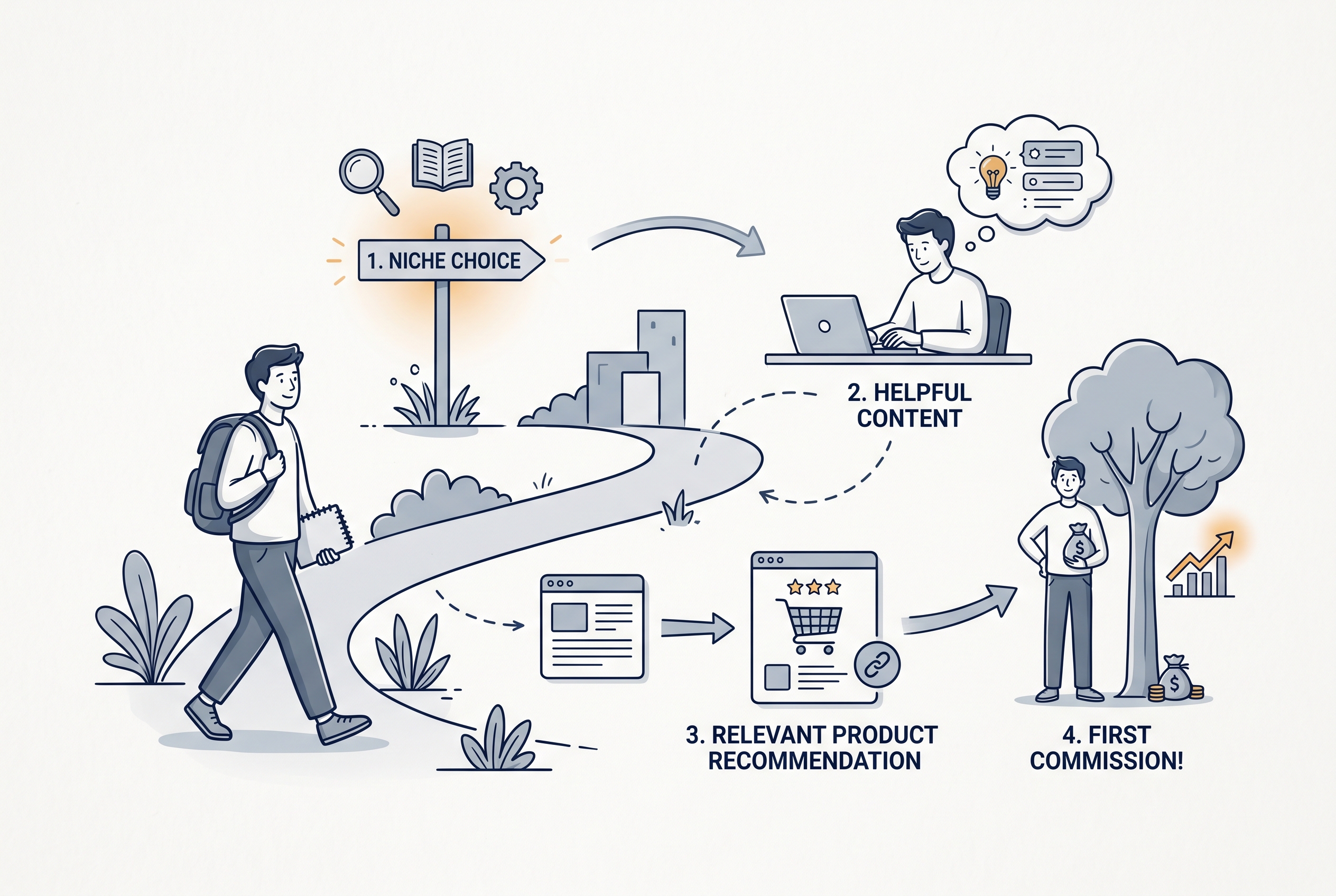
Think in systems, not hacks. A strong beginner setup usually stands on these three parts.
Pick a topic where people have recurring questions, obvious friction, and products that can genuinely help. Better fit usually beats bigger commission tables.
The payout matters, but trust matters more. If you would feel awkward recommending the product without a commission, it is usually the wrong product.
Your page should reduce uncertainty before it asks for a click. Calm explanations, comparisons, and step-by-step help usually outperform hype.
Helpful content wins
This is where a lot of people get lost. They think affiliate marketing is about link placement. It is not. It is about helping a reader make a better decision.
That is why calm reviews, plain-English how-to guides, honest comparisons, and simple resource pages tend to outperform breathless copy. Useful content lowers friction. Hype adds friction.
If a page answers the question clearly, shows the trade-offs, and only then points to the offer, the recommendation feels natural. That is the version that tends to last.
Common traps
Beginner mistake
Start with a real problem you can explain clearly, then match offers to that problem instead of the other way around.
Beginner mistake
Explain the decision, the trade-offs, and the use case first. Then the link feels helpful instead of forced.
Beginner mistake
Affiliate marketing for beginners works better when the first goal is useful content, not screenshots and instant income fantasies.
You do not need a fancy website to begin. You need one useful page that answers a real beginner question cleanly.
Action step
→ Pick one topic you can explain without forcing it.
→ Check whether the topic has real questions and real affiliate offers.
→ Publish one page that helps a beginner make a better decision.
→ Track what people click, ask, and search for, then improve from there.
Keep going
These guides help you go deeper into the model, pick a better niche, and decide whether the effort fits you.
Ready to take the next big step?
Go to the Full Roadmap